
2017 - IPITA
This page contains exclusive content for the member of the following sections: TTS, IPITA. Log in to view.
Immunobiology & Immunosuppression 2
39.7 - Immunosuppression Using NFκB Inhibitor Withaferin A
Presenter: M, Kanak, Richmond, United States
Authors: Mazhar Kanak, Michael Lawrence, Marlon Levy, Bashoo Naziruddin
Immunosuppression Using NFκB Inhibitor Withaferin A
M. Kanak1, M. Lawrence2, M. Levy1,3, B. Naziruddin4.
1Department of Surgery, Transplant Division, Virginia Commonwealth University, Richmond, USA, ; 2Islet Cell Transplant Lab, Baylor Research Institute, Dallas, USA, ; 3Hume-Lee Transplant Center, Virginia Commonwealth University Health System, Richmond, USA, ; 4Simmons Transplant Institute, Baylor Scott and White Health, Dallas, USA,
Aim of Study: The development of steroid-free protocol by the Edmonton group revived islet transplant as a potential therapy to cure type-1 Diabetes. However, long-term dysfunction in islet transplantation is a major challenge that needs to be addressed. Recent immunosuppression protocols are toxic to the beta cells resulting in chronic graft failure. There is an unmet need for a more suitable immunosuppressive regimen that maintains long term beta cell function. Withaferin A (WA) is a plant-derived molecule which has been used as an anti-inflammatory molecule because of its ability to block Nuclear Factor Kappa B (NFκB) pathway. Since, immune cell activation is regulated by NFAT, AP-1 and NFκB, we hypothesized that WA can be used to suppress this activation. The purpose of this study to demonstrate the immunosuppressive ability of WA in vitro.
Methods: Human and mouse islets were cultured with or without WA at various concentrations and viability was measured to demonstrate safety. Splenocytes were extracted from C57BL/6 mice and stained with 10uM CFSE for 10 mins. Stained cells were stimulated with equal numbers of CD3/CD28 beads in the presence or absence of 1ug/mL WA and cultured for 5 days. T cell proliferation and surface marker analysis for CD4, CD8 and CD25 was determined using flow cytometric analysis. Experiments were also repeated using mouse T cells and human T cells purified from PBMCs.
Results: There was no significant change in the viability of islets up to a concentration of 1ug/ml WA. Flow cytometric analysis revealed that the proliferation of T cells was significantly inhibited by WA in mouse splenocytes, purified T cells and human T cells [Figure 1]. Further analysis of markers revealed significant reduction in CD4 and CD8 T cell numbers but the percentage was unaffected.
Conclusion: A low dose of WA showed no toxic effect on Islets. T cell activation was significantly inhibited by WA. The use of WA with no beta cell toxicity has the potential to become a favorable immunosuppressive agent for islet transplantation.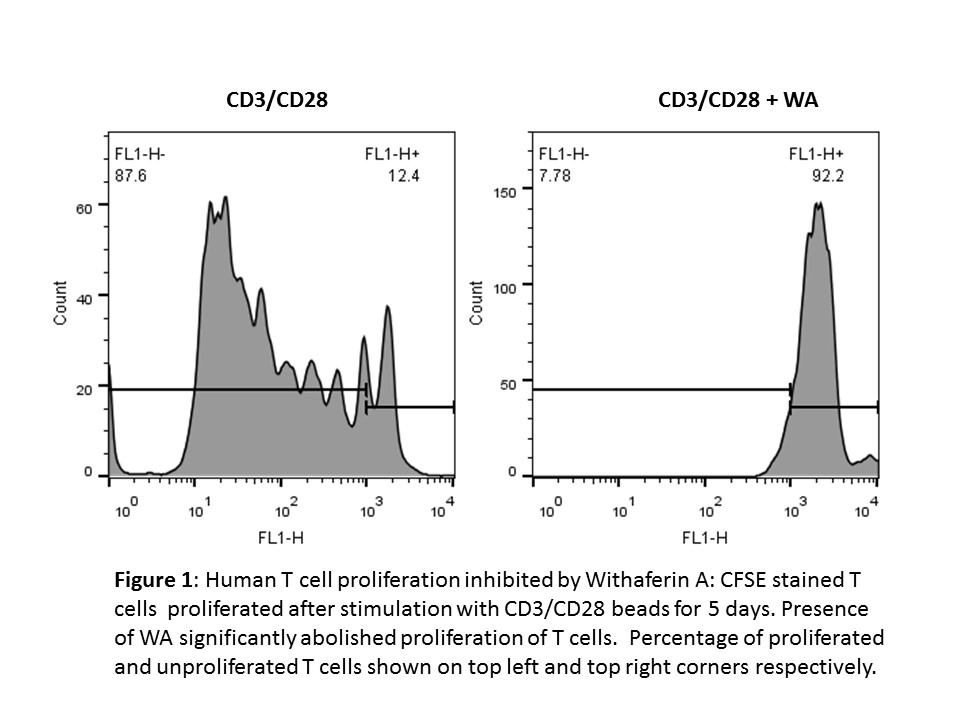
Important Disclaimer
By viewing the material on this site you understand and accept that:
- The opinions and statements expressed on this site reflect the views of the author or authors and do not necessarily reflect those of The Transplantation Society and/or its Sections.
- The hosting of material on The Transplantation Society site does not signify endorsement of this material by The Transplantation Society and/or its Sections.
- The material is solely for educational purposes for qualified health care professionals.
- The Transplantation Society and/or its Sections are not liable for any decision made or action taken based on the information contained in the material on this site.
- The information cannot be used as a substitute for professional care.
- The information does not represent a standard of care.
- No physician-patient relationship is being established.
Contact
Address
The Transplantation Society
International Headquarters
740 Notre-Dame Ouest
Suite 1245
Montréal, QC, H3C 3X6
Canada
Используйте Вавада казино для игры с бонусом — активируйте промокод и начните выигрывать уже сегодня!